Hanna
Zawa-Cywińska
The painter who gave geometric abstraction a living surface — strict structure above, a pulsing field of color beneath.
Painting · Printmaking · Sculpture · Material Experimentation
Poland · France · United States · Switzerland
Between technology and emotion.
Between order and freedom.
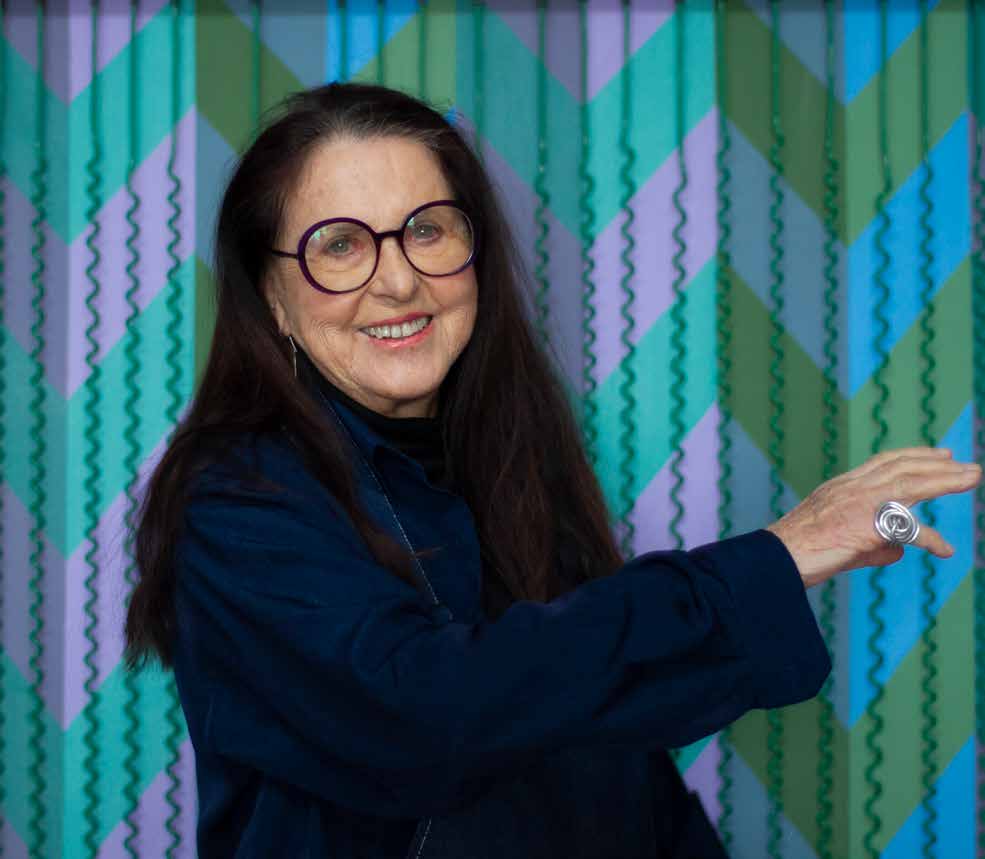
Hanna Zawa-Cywińska’s practice cannot be understood through geography alone.
She moved between countries, between disciplines and between ways of thinking. Born in Łomża in 1939, trained in biology and biochemistry, she left Poland in the nineteen-sixties, passed through Italy and France, and arrived in the United States, where she remained from 1967 until 1994. Since then her life has been divided between Switzerland and Poland.
Her scientific background brought precision, patience and an understanding of systems: a habit of working in series, of testing a hypothesis across many surfaces. Her artistic practice introduced intuition, color, matter and freedom.
These two worlds never cancelled each other out. They became the foundation of her art — a body of work in which a strict geometric structure is laid over a layer that breathes, vibrates and refuses to be entirely controlled.
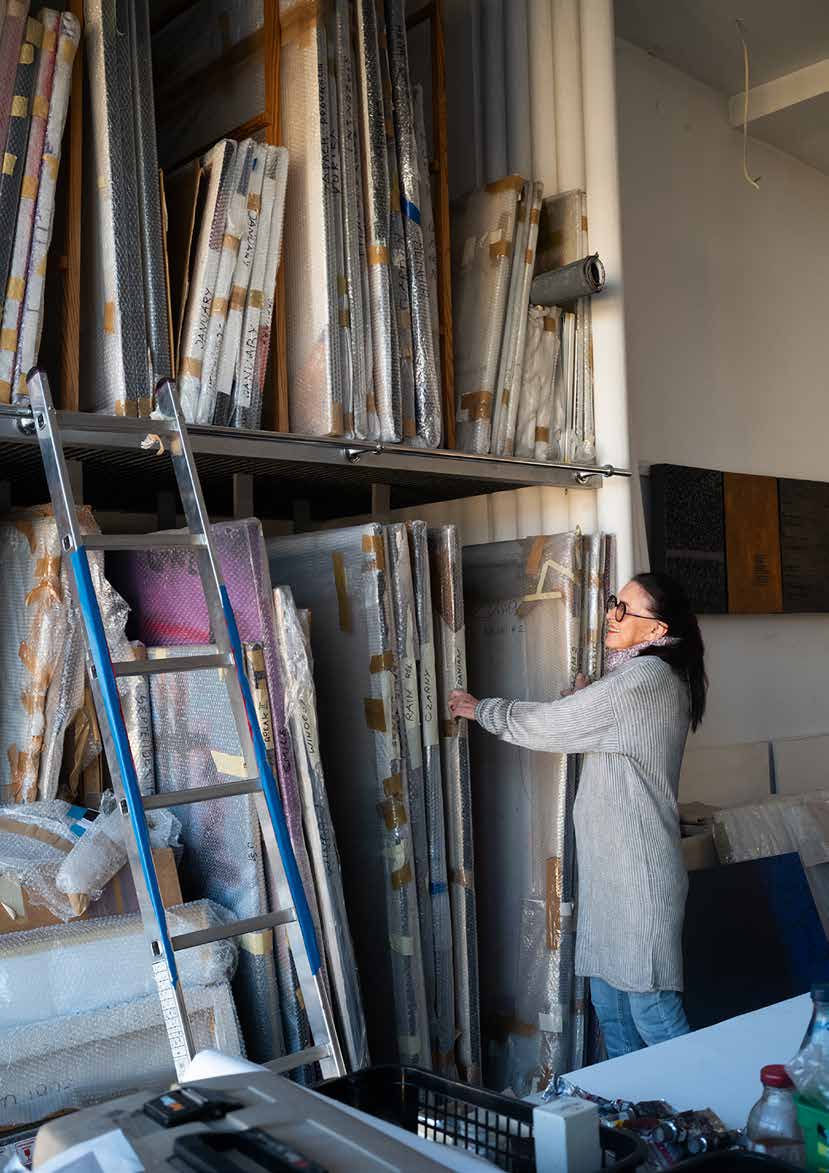
The artist in her studio
A life that begins twice
Her father, a judge, was killed in 1943 during a bombing raid on Warsaw in World War II. Mother and daughter moved to Łódź, where Hanna began studying biology and married the engineer Józef Cywiński. In Warsaw she completed a degree in biochemistry and postgraduate studies in journalism.
In the nineteen-sixties the family decided to leave Poland. The route ran through Italy and France, where they spent almost two years, and ended in the United States. Philadelphia came first — scientific work, then an attempt to continue as a journalist, frustrated by the barrier of a new language.
Only in New York, in the nineteen-eighties, did her second life begin. She enrolled at the Fashion Institute of Technology to study advertising, and there encountered printmaking. A teacher told her to keep going. She did — and never stopped. Another inspiration was time spent at Wojciech Fangor’s upstate New York property with her husband and son Mark.
She did not abandon science when she became an artist.
She transformed it into a visual language.
America
where the artist emerged
America was not simply a period spent abroad. It was the place where an artist came into being. Philadelphia was the beginning: laboratories, a language still being learned, a family to raise. New York was the breakthrough.
In the city she found teachers, presses, a community of émigré artists and a working vocabulary of her own. At the Polish American Artists Society she exhibited alongside Richard Anuszkiewicz and Julian Stańczak — two of the central figures of American Op Art, both of Polish origin — and the encounter placed her own experiments with vibration, grid and after-image inside a live American conversation.
What she took from it was not a style. It was a permission.
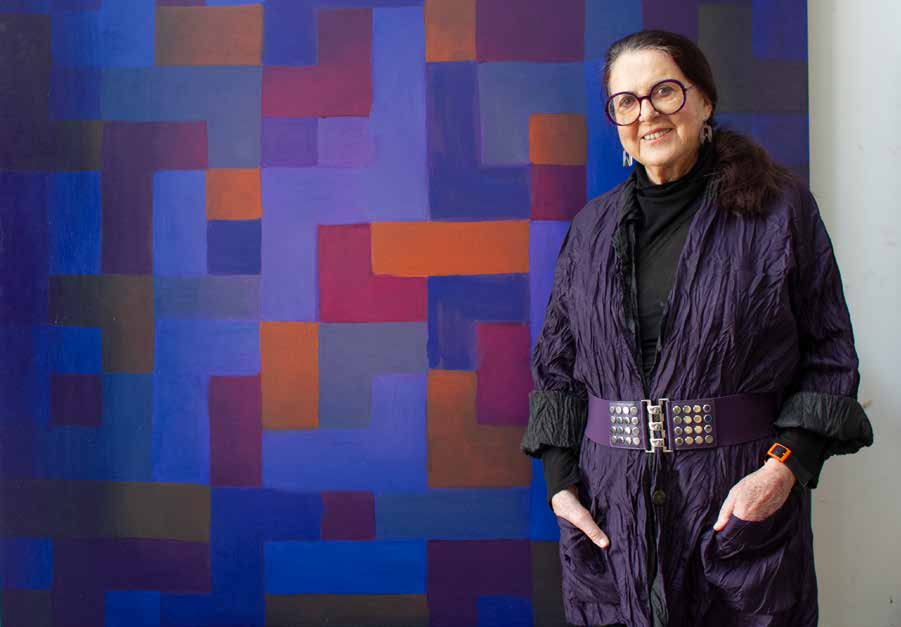
The artist with Vortex
“Don’t copy. Search for yourself.”
Professor Priscilla Schwartzchild · State University of New York at Purchase
Cable Paintings
Technology transformed into painting.
Decodalizer, 1983/1984 — details. Cable, acrylic, canvas.
The Cable Paintings emerged in America from an unexpected encounter between art and technology.
Józef Cywiński, the artist’s husband, was an engineer and inventor working with medical technology. Hanna looked at the cables used in this environment and saw something entirely different.
Not engineering. Line. Rhythm. Tension. Energy.
She introduced coiled cable in front of the painting’s surface. The technological object became part of the artist’s palette. The line became physical. The painting became an object.
Communication II, 1983/1984 — detail.
They are physical objects that behave like paintings.
When someone recognized what she was doing
David Bermant was an American collector with an unusually specific field of attention: the point at which art meets science, technology, light, movement and perception. His collection, known as Color, Light, Motion, gathered work that could not be explained by painting history alone.
Bermant noticed the Cable Paintings. In the broader collecting context in which he worked, names such as Nam June Paik, Jean Tinguely and Jesús Rafael Soto define the territory — artists who made electricity, mechanics and optical energy into subject matter. Zawa-Cywińska never collaborated with them; her work simply belongs to the same puzzle.
Exhibition
High-Tech-Art
MIT Museum, Cambridge, Massachusetts
New England Center for Contemporary Art, Brooklyn, Connecticut
1987
Seen from Cambridge in 1987, the cable relief was not an eccentric technique. It was part of an international history of art and technology that is only now being written in full.
“Zawa modernized geometric abstraction because she dared to personalize it.”
Vortex, 1990 · Acrylic on canvas · 137 × 137 cm
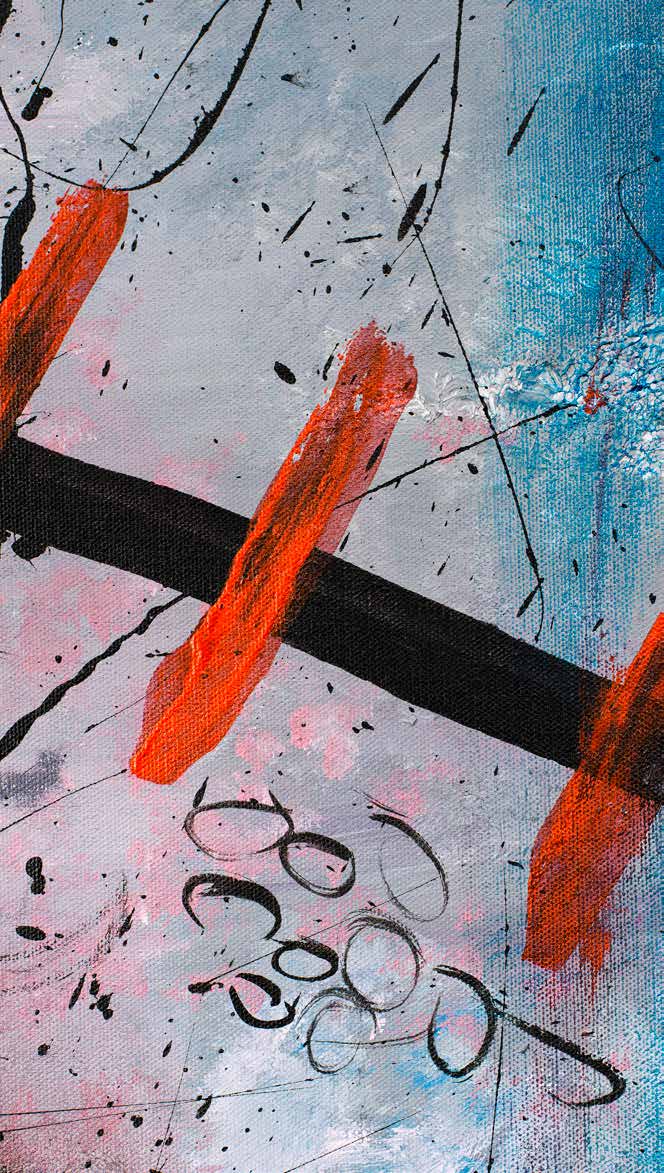
Geometric abstraction is hard modernism, known for its cool, impersonal aesthetic. Zawa-Cywińska keeps its discipline — the grid, the screen, the strict upper layer — and then places beneath it something that is anything but impersonal: a shimmering, pulsing field of color that seems to be alive. Her work often has tension between the element of structure and random flow.
The two layers are a proposition about freedom. One speaks of the individual need for openness, the other of a being answerable to social norms. Their successful integration is an optimistic answer to that dilemma.
She wanted the geometric screens laid over her paintings to function as a space in which the viewer could look for their own affinities and associations.
Josephine Gear · New York, 1991
“Her paintings prove that at least one more chapter can be written about geometric abstraction.”
Flirt
with
Kandinsky
While searching for old papers for collage in a New York shop selling second-hand books, newspapers and printed matter, Zawa-Cywińska encountered a bundle of trial impressions originating from the studio of Wassily Kandinsky.
Aware of their historical significance, she did not immediately use them. She sought advice concerning the ethical implications of incorporating the fragments into new works. Only after receiving approval did she begin, in 1988, the series she gave the deliberately light-hearted title Flirt with Kandinsky.
From behind matte black, or behind the even rhythm of a linocut structure, strips and geometrically cut openings reveal fragments of colored lithographic composition by the author of the first abstract watercolor.
Not imitation.
Not appropriation.
A conversation.
Her own graphic structures interact with fragments carrying the visual history of Kandinsky. Two artistic languages meet without one disappearing into the other.
When the surface became alive
In subsequent years the artist began experimenting with a new medium she discovered by chance in New York — Expancel, a thermo-expandable material used until then exclusively in technical industry. The discovery proved a breakthrough. Expancel became the material Zawa-Cywińska remained bound to for many years, her favourite, almost organic partner in the creative process.
She was fascinated that the substance reacts to heat and light, changing its structure in unpredictable ways. One never knows what the final effect will be — and this uncertainty, this elemental character of the medium, fit her creative philosophy perfectly: the combination of control and intuition, construction and emotion.
"It was a moment when I felt I could create matter that lives," she recalled.
For Hanna Zawa-Cywińska, Expancel became more than a technique — it was a metaphor for the process of life itself: expansion, transformation, reaction to light and heat. Through it her paintings gained corporality, depth and a delicate movement, as if breathing with the space around them.
Webb, 1993 — detail. Acrylic and thermo-expandable substance on canvas.
Between Construction and Emotion
like the people who look at them.
Hanna Zawa-Cywińska
The Works
Select any plate to view it enlarged · Arrow keys to move through the sequence
Structure, Material, Space, Balance
Zawa-Cywińska never needed to become a sculptor to challenge the boundary between painting and object.
From the Cable Paintings created during her American period, the surface of the canvas was no longer simply a plane. Real industrial cable entered the work, creating relief, shadow, rhythm and physical depth. Painting began to occupy space.
From 1999, the artist travelled across Europe to encounter menhirs and megaliths. The resulting cycles — Megaliths, Menhirs, Stones — continued this exploration through another language. These remained paintings, yet they carried qualities we instinctively associate with sculpture: weight, monumentality, surface, matter and physical presence.
The canvas remains a painting, but begins to behave like an object.
This relationship between painting and physical form runs through Zawa-Cywińska’s practice — from the actual cables embedded in her American works, through experiments with Expancel, to the monumental forms of the Menhirs.
Significantly, a Cable Painting by Hanna Zawa-Cywińska is held in the collection of the Centre of Polish Sculpture in Orońsko. Its presence there offers an intriguing institutional context for an artist who consistently expanded painting beyond the conventional picture plane.
Menhirs and Megaliths — surface details, artist’s own technique.
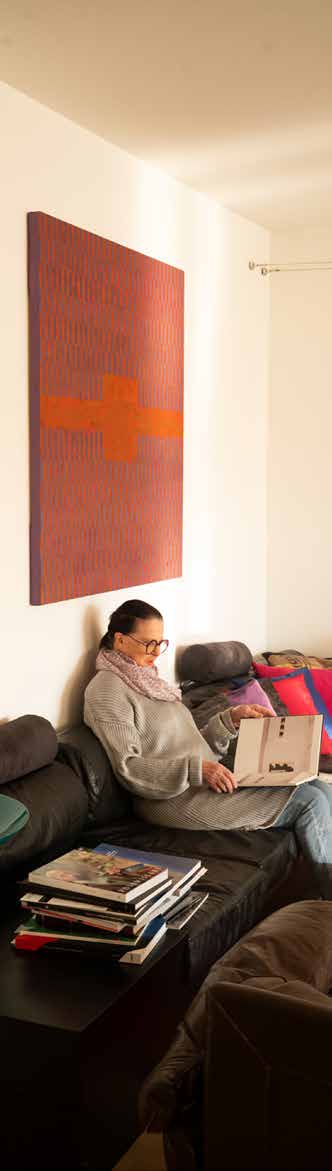
Archival photograph
The American Years
- The Bronx Museum of the Arts, Satellite Gallery, New York
- Art Museum, Fort Lauderdale, Florida
- Springfield Art Center, Springfield
- Museum of Art, Fairbanks, Alaska
- High-Tech-Art, MIT Museum, Cambridge, Massachusetts
- New England Center for Contemporary Art, Brooklyn, Connecticut
- The Art Complex Museum, Duxbury, Massachusetts
- Hanna Zawa-Cywińska (solo), State University of New York, Purchase
- New York City Library, New York
- Chappaqua Library Gallery, Chappaqua, New York
- Westchester College, Valhalla, New York
- Dunphy’s Studio, New York
- Art Gallery of Tennessee University, Chattanooga
- Mississippi University Museum
- Chapman Gallery, University of Tulsa, Oklahoma
- André Zarre Gallery, New York
- New Constructivism, Jagendorf-Bacchi Gallery, New York
- Preview Gallery, New York
- PAAS Gallery, New York
- Megality, Consulate General of Poland, New York
Migration shaped the conditions of the work, not its subject. What travelled with her was a method: two layers, one disciplined and one free, held in a single surface.
Institutional Presence
First acquisition of its kind
The Art Complex Museum in Duxbury, Massachusetts, acquired a painting by Hanna Zawa-Cywińska as the first work of its kind ever entered into the museum’s collection in its history.
Shortly afterwards her work also entered the collection of the MIT Museum in Cambridge — an institution devoted to the meeting of science, technology and art, where the Cable Paintings were read not as an eccentric technique but as part of an international history still being written.
A note · Marbella
A work from Flirt with Kandinsky is planned for presentation at the Museo del Grabado Español Contemporáneo in Marbella, in the Joan Miró Room, alongside serigraphs by Joan Miró. The presentation is forthcoming.
There are artists whose importance is immediately visible because history has already created a place for them. And there are artists whose work asks us to look again. Hanna Zawa-Cywińska belongs to the second group.
Her practice connects several histories that are being reconsidered today.
- Geometric abstraction
- Op Art
- Art and technology
- Women artists working across borders
- Émigré artistic networks
- Material experimentation
- The dialogue between European and American post-war art
Yet her work does not fit neatly into any one of them. Perhaps that is precisely what makes it worth returning to.
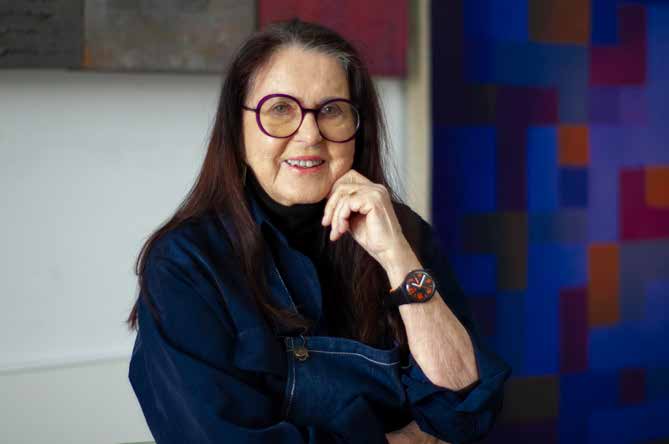
Hanna Zawa-Cywińska
An artistic practice spanning more than five decades.
More than 50 solo exhibitions.
More than 150 group exhibitions.
Poland · United States · France · Switzerland · Germany · Belgium · Japan
Her work continues.
Looking forward
2028
A major international exhibition project devoted to Hanna Zawa-Cywińska is currently being developed for 2028. Conceived as a travelling museum presentation, the project will retrace the geography of the artist’s life and work.
The exhibition is intended to bring together key works from different periods of her career, including the American Cable Paintings, geometric abstraction, Flirt with Kandinsky, material experiments and sculpture, alongside archival material documenting a life lived between disciplines and continents.
Poland
→
France
→
Switzerland
→
United States
Between Order and Freedom
Hanna Zawa-Cywińska
International Exhibition Project
2028